 +1 (314) 576-1400
National Zoo Switcheroo: Gelding Is a Stallion Again
by Fran Jurga
Monday, June 16, 2008
The National Zoo is reporting that it reversed an equine vasectomy procedure performed on Minnesota, an endangered male Przewalski’s Horse in the zoo’s herd. This is the first procedure of its kind to be performed on an endangered equid species.
“The major challenge we faced was that this procedure had never been performed on an equid, let alone a critically endangered species,” said Dr. Budhan Pukazhenthi, a reproductive scientist at the National Zoo’s Conservation and Research Center in Front Royal, Va. “We had to develop all new protocols ourselves.”
The team sought the expertise of Dr. Sherman Silber, a St. Louis-based urologist who pioneered microsurgery for reverse vasectomies in humans and had been successful in vasectomizing and then subsequently reversing vasectomies in rare South American bush dogs at the St. Louis Zoo.
“Although our team is very experienced in horse anesthesia and surgery, by using the specialized professional skills of Dr. Silber, we greatly increased the likelihood of success,” said Dr. Luis Padilla, associate veterinarian at the Conservation and Research Center.
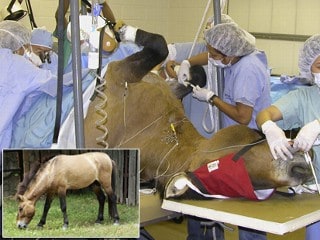
Silber, working with the Zoo’s team of veterinarians and reproductive scientists, performed the operation on Minnesota in October 2007. Silber was confident that if the horse could be placed on its back, the procedure would be a success. Laying an anesthetized horse on its back for a prolonged period of time can be challenging due to their size and physiology. Veterinarians decided it could be done, but only if the surgery time was kept to a minimum. In October 2007, the team operated on Minnesota again—completing the procedure in an hour. Six months later, the Zoo’s veterinarians and reproductive scientists collected a semen sample from the horse that indicated the procedure had been a success.
National Zoo staff and a human urologist perform a reverse vasectomy on Mine sot a, a Przewalski’s Horse for the second time on October 10, 2007, after the first attempt proved to be unsuccessful. Veterinarians placed Minnesota on his back for this procedure — a delicate task that limited the amount of time for the surgery, but allowed better access to the surgical site. Six months later, the Zoo’s veterinarians and reproductive scientists collected a semen sample from the horse that indicated the procedure had been a success.
“I’ve always dreamed of using my expertise to contribute in some way to wildlife survival,” said Dr. Silber.
National Zoo scientists hope to pair Minnesota with a suitable female later in the coming months. His genes will infuse genetic diversity in a Przewalski’s Horse population that is based on genes from only l4 original animals. National Zoo scientists are researching ways to improve fertility and produce more offspring in the aging, captive population. Bolstering the population translates into more horses for future reintroduction programs, essential for a critically endangered species.
Currently, National Zoo scientists are working in remote areas of China using radio collars and Geographic Information System technology to map the movements of Przewalski’s Horses reintroduced by Chinese colleagues into their former habitat.
This breakthrough also has important implications for how endangered species in captivity are managed. The new knowledge could allow males and females of a species to be exhibited together but temporarily prevented from producing offspring if the Species Survival Plan—a cooperative breeding program among zoos—does not recommend them for breeding.
Przewalski’s Horses are a horse species native to China and Mongolia that was declared extinct in the wild in 1970. Currently, there are approximately 1500 of these animals maintained at zoological institutions throughout the world and in several small reintroduced populations in Asia.