PGD - Pre-Implantation Genetic Diagnosis MVR - Microscopic Vasectomy Reversal ART Pregnancy Rates Sheet IVF - In Vitro Fertilization ICSI - Intra Cytoplasmic Sperm Injection Tubal Ligation Reversal Vasectomy Reversal vs. Sperm Injection: Dr. Silber’s Analysis Sperm, Embryo, and Ovarian Tissue Freezing and Storage Understanding Infertility Treatment Statistics Video:  Dr. Silber explains Assisted Reproductive Technology "How To Get Pregnant" - Dr. Silber's book "What’s New in Infertility" - Commentary by Dr. Silber Sperm Aspiration for ICSI Blastocyst Culture Video and Audio Library GIFT - Gamete Intra Fallopian Transfer Video:  Dr. Silber explains Microscopic Vasectomy Reversal Bibliography of Dr. Silber Biography of Dr. Silber Radio:  The biological clock discussed with Joan Hamburg TV:  Ovarian tissue transplantation on Montel Williams Preserving Your Fertility TV:  Antral Follicle Count (egg counting) TV:  Freezing the Biological Clock TV:  How to Find Out Where You Are On Your Biological Clock TV:  Dr. Silber Honors His Early Teacher on NBC News Today Show Dr. Silber explains egg and ovary banking to preserve fertility Whole Ovary Transplant Between Non-identical Sisters - Channel 11 St. Louis News Video Clip Whole Ovary Transplant Between Non-identical Sisters - Fox News St. Louis Video Clip Mini-IVF - Fox News St. Louis Video Clip
The Infertility Center of Saint Louis LogoThe Infertility Center of Saint LouisThe Infertility Center of Saint LouisSt. Luke's Hospital, Saint Louis, Missouri

GIFT  Gamete Intra-Fallopian Transfer

GIFT (Gamete Intra-Fallopian Transfer)

GIFT is an early, and very simple ART (Assisted Reproductive Technology) technique devised in the 1980s to achieve pregnancies in most couples who have not been able to conceive using conventional treatments for infertility (despite having good sperm and normal fallopian tubes). Most infertility patients will have their best chance of pregnancy with some sort of ART procedure, and GIFT is the only ART approach that is completely acceptable to the Roman Catholic Church. The success rate with GIFT is even somewhat higher than with standard IVF (in vitro fertilization), but GIFT can be performed only if the patient has normal fallopian tubes and adequate sperm. For cases with abnormal fallopian tubes, IVF is mandated. For cases with poor sperm, we recommend the ICSI procedure pioneered by us and our Belgian collaborators.

GIFT stands for "Gamete Intra-Fallopian Transfer." Gametes, i.e., the female's eggs and the male's sperm, are washed and placed via a catheter directly into the woman's fallopian tubes. This usually involves a minor surgical procedure which allows you to go home the same day with a minor degree of pain that lasts for just a few days. With GIFT, fertilization occurs inside the woman's body (not outside), and mimics the way a normally fertilized egg would begin its journey to the uterus for implantation. Understanding this older and more "natural" ART treatment is helpful for understanding the newer, more complex treatments.

How Does Gift Work?

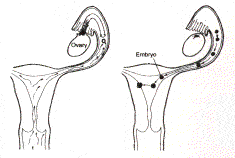
In a fertile couple, pregnancy begins with the release of an ovum (egg) from the woman's ovaries. The egg enters the fallopian tube where it meets with sperm that have traveled there, following intercourse, from the vagina. The sperm normally fertilize the egg in the fallopian tube. The fertilized egg, now called an embryo, begins to divide and in four days, contains many cells. At this time, the embryo moves from the fallopian tube to the uterine cavity where it "floats" for another two days. The embryo then implants in the uterine wall, and becomes a pregnancy.

Normal fertilization in fallopian tube
Left: Normal fertilization in fallopian tube. Right: Implantation in uterus
Implantation in uterus

The GIFT technique follows nature by allowing the eggs to fertilize and develop in the natural environment of the fallopian tube, and then to make their way to the uterus for implantation according to a normal timetable. In contrast, in vitro fertilization (IVF) places fertilized eggs directly into the uterus. One of GIFT's major advantages over IVF is that the technique relies to a far greater degree on the body's natural processes and timetable to produce pregnancy, and is acceptable to those religious groups which avoid the more embryo invasive technologies. In technical IVF terms, we would say that it is the best of all methods of "co-culture".

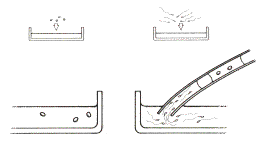
The fluid containing the eggs is placed in a laboratory dish and observed under a microscope. The egg is located and its stage of maturity noted. It is then carefully cultured in a special nutrient. Sperm and eggs are sequentially loaded into the catheter, which is then introduced into the patient's fallopian tubes through a tiny incision in her abdomen.

Prior to any GIFT, IVF, or ICSI procedure, the woman receives hormones to stimulate development of the ovarian follicles, which are sac-like structures that contain the eggs.Prior to any GIFT, IVF, or ICSI procedure, the woman receives hormones to stimulate development of the ovarian follicles, which are sac-like structures that contain the eggs. Administering these hormones allows us to retrieve many ripened eggs, and thus increase the chance of pregnancy.
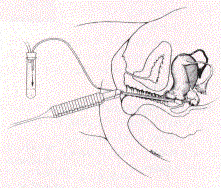
The sperm is washed and prepared for loading into the same catheter into which several of the wife's best eggs will be placed.Approximately three hours before the procedure, a semen sample from the husband is obtained. The sperm is washed and prepared for loading into the same catheter into which several of the wife's best eggs will be placed. The eggs are obtained by transvaginal needle aspiration (no surgical incision) via an ultrasound guide.

The fluid containing the eggs is placed in a laboratory dish and observed under a microscope. The egg is located and its stage of maturity noted. It is then carefully cultured in a special nutrient. Sperm and eggs are sequentially loaded into the catheter, which is then introduced into the patient's fallopian tube through a tiny incision in her abdomen.

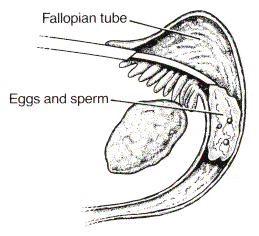
The eggs and sperm are then released into the fallopian tube.


The eggs and sperm are then released into the fallopian tube. The number of eggs returned to the patient depends on the wife's age and egg quality. This procedure can be performed surgically either through laparoscopy or a small, one-inch "mini-lap" incision in the lower abdomen, under general anesthesia. It takes place in our technologically advanced operating room and lab, with a highly controlled environment to prevent any inadvertent toxicity to the eggs, sperm, or embryos.

The "gametes" thus meet in the fallopian tubes where the fertilization process is allowed to happen naturally. The resulting embryos are nurtured there, and then move down into the uterus for implantation. The patient goes home the same day. It is strictly intended to be an outpatient procedure.

Chance for Pregnancy

GIFT is not nearly as popular as IVF today; nonetheless there is still a 50% pregnancy rate per retrieval cycle for GIFT. In older women the pregnancy rate is lower. If an older woman is fortunate enough to yield many eggs, her pregnancy rate can be made equivalent to that of a younger patient by putting in more eggs. GIFT or ZIFT (a variation of GIFT whereby embryos are first fertilized in vitro, and then transferred to the fallopian tubes) actually gives a considerably higher pregnancy rate in older women with cervical abnormalities.

If any ART cycle — GIFT, ZIFT, IVF, etc. — fails to achieve pregnancy, you should consider undergoing more cycles in the future. If you don't get pregnant in your first cycle (and there are no egg problems) you can still get pregnant in subsequent cycles, and the pregnancy rate still remains just as high.

If your fallopian tubes are damaged, you would require IVF even if GIFT or ZIFT would have been your preference otherwise. If your sperm is poor, that is no problem whatsoever. You would then undergo an amazing procedure called IVF/ICSI, which we actually helped develop with colleagues in Brussels, Belgium.

See also:

If you have any questions, you may call us at  (314) 576-1400.

Learn more about Dr. Silber The Infertility Center of St. Louis The Infertility Center of St. Louis