+1 (314) 576-1400


 Contact Us

Mini IVF, also called minimal stimulation IVF, is a fertility treatment that uses lower doses of fertility medication than conventional IVF to stimulate egg development. Eggs are retrieved and fertilized in the laboratory, and a resulting embryo can be transferred to the uterus to pursue pregnancy.
At the Infertility Center of St. Louis, Dr. Sherman Silber offers Mini IVF as an approach that may reduce medication costs, the number of injections, and the risk of ovarian hyperstimulation. It may be an option for women with low ovarian reserve, older women, and patients seeking treatment with less medication. The best approach depends on your fertility evaluation, expected ovarian response, and family goals.
Mini-IVF Yields Better Quality Eggs
What is Mini IVF?
Mini-IVF is tricky to perform well and many centers are not up to it. It is easier for the patient and more difficult for the doctor. There is no margin for error. There are several reasons for the success we have with these much lower cost mini-IVF techniques.
The success of this approach depends not only on a novel endocrine stimulation protocol, but also upon a flawless method of embryo freezing such as our vitrification system, and the highest level laboratory air purification system to give the eggs especially from older women the best possible environment in which to develop.
Who may benefit from minimal stimulation IVF?
With our mini-IVF approach of storing up vitrified embryos month by month in older women, we have remarkable pregnancy rate even in women over 42-years of age of over 50%. But it takes a great deal of patience on the part of the patient to retrieve just a few eggs at a time every month until enough embryos are banked to warrant thawing and transfer. In addition, the endocrinology of mini-IVF is very innovative and requires close attention to each individual patient to avoid premature ovulation.
Mini IVF vs. conventional IVF
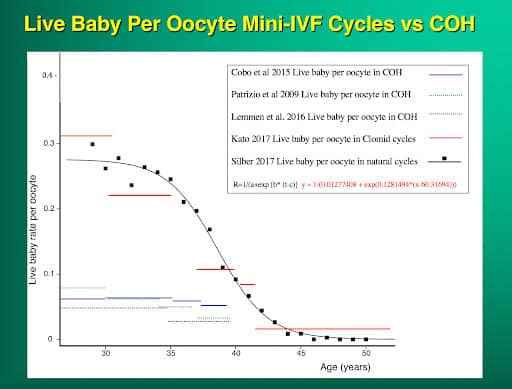
Take a look at this graph showing live baby rate per egg with Mini-IVF compared to conventional ovarian stimulation. The baby rate per egg is 4 to 5 times greater with Mini-IVF at any given age. Even at older ages, the baby rate per egg is four to five times higher than with high dose hyperstimulation. Please note, we use now use Mini-IVF for all patients, good prognosis and poor because at any age the baby rate per egg is 4-5 times higher.
Mini-IVF was first developed by the Kato Ladies Clinic in Japan and then perfected and popularized by us at St. Luke’s Hospital in St. Louis. It takes advantage of your own natural FSH elevation with an ingeniously simple protocol that strives for smaller numbers of better quality eggs. Instead of massive doses of expensive hormones to try to blast out a few poor quality eggs, it more naturally teases out of even older ovaries their best quality eggs with a carefully devised protocol of minimal stimulation. There are no symptoms of huge hormonal swings or hyperstimulation. It is easier on the patient and much cheaper than conventional IVF.
Dr. Silber discusses Mini IVF treatment options, patient stories and scientific research.








Is Mini-IVF Always Used ?
No, it is most useful for older women and women with low ovarian reserve. There are still many patients who are happy with conventional stimulation. However many of these women also may prefer mini-IVF because of the lower cost and the lack of any risk of hyperstimulating syndrome. Even younger patients prefer mini-ivf because of much lower cost, no hyperstimulation syndrome risk, and frankly, better results.
How much does Mini IVF cost?
The cost of Mini IVF depends on your treatment plan, medication needs, and the number of cycles required. Because minimal stimulation IVF uses lower doses of fertility medication, it may reduce medication expenses compared with conventional IVF. Your total investment also depends on the laboratory services and embryo transfer procedures needed.
When comparing costs, ask whether your estimate includes monitoring, egg retrieval, anesthesia, fertilization, embryo freezing, storage, and frozen embryo transfer. Medications and additional services may be billed separately.
Some patients may need more than one egg retrieval to obtain embryos for transfer or future family building. Additional retrievals, medications, and transfers can increase the total cost of treatment.
Contact the Infertility Center of St. Louis at (314) 576-1400 to discuss Mini IVF costs and request an estimate for your care.
How does Mini IVF work?
Mini-IVF is designed to recruit only a few (but high quality) eggs, thus avoiding the risks of hyperstimulation, reducing the number of injections and dramatically reducing the cost of medications. However quite remarkably, we are now finding that with the lower dose mini-ivf protocol, we are actually getting more eggs as well as better quality eggs. In many patients who had very poor quality embryos with conventional IVF stimulation protocols, mini-IVF dramatically improved their embryo quality and resulted in pregnancy in otherwise “hopeless cases”. This approach is not just a simple-minded reduction in hormonal stimulation. It is an ingeniously conceived and completely different stimulation protocol that saves the patient much of the complexity and cost associated with more conventional IVF protocols. Here is how it works:
On day 3 of the menstrual cycle, you start on a low dose of Clomid (50mgs), but you do not stop the Clomid in five days, as is usually the custom. You keep taking the Clomid until ultrasound monitoring shows the follicles to be ready for ovulation. A very low “booster” dose of gonadotropin (just 150iu of FSH) is added on days 8, 10, and 12. Clomid not only stimulates your own pituitary to release FSH naturally (by blocking estrogen’s suppressing effect), but when you continue the Clomid (a new approach), it blocks estrogen’s stimulation of LH release, and also usually prevents premature ovulation. Thus, with this simple change in protocol, the old-fashioned, inexpensive Clomid is able to stimulate the development of great-quality eggs for IVF.
Another advantage of this protocol is that you do not have to go on Lupron first to suppress the pituitary. Staying on Clomid blocks estrogen from stimulating your pituitary to release LH, and this added effect of Clomid will prevent premature ovulation. This means that you can be induced to ovulate with just a simple injection or nasal sniff of Lupron. This causes a more natural LH surge and avoids the defect caused by the prolonged effect of an HCG trigger. This leads to more “natural” maturation of the eggs.
The next step is to recognize that Clomid has a temporarily negative effect on the uterus (because it blocks estrogen’s support of the developing endometrial lining). That is one reason why results in the past have been so poor with the use of Clomid for ovarian stimulation. The embryos are less likely to implant in such an endometrium. But that problem is now easily solved by using the Japanese protocol for embryo freezing, “vitrification” which I discuss elsewhere. We can now freeze the embryos almost with impunity using this approach. Then these embryos are transferred a few months later in an endometrium that is more perfectly receptive.
For poor prognosis cases of older women with low remaining ovarian reserve, there is a huge advantage to mini-IVF over high-dose stimulation. Such patients normally yield very few eggs anyway, even with huge megadoses of gonadotropin. If they have any good-quality eggs remaining, mini-IVF is just as likely to yield as many eggs as giving huge megadoses of gonadotropin which in a sense would “poison” those eggs because of too high a level of FSH. Even in the worst case scenario, if there are no good eggs left at all, at least you can discover this with only $1,500 spent on drugs instead of $7,000 (the cost of the maximum dosage).
Clomid only prevents premature LH surges 90% of the time, so we cleverly prevent premature LH surges even in thse cases by paying close attention to each individual patient, monitoring their LH very attentively and by using both a low dose of GnRH antagonist and indocin when needed. So we never encounter the problem most physicians fear, of premature ovulation.
To get feedback from patients who have undergone treatment at our Center, click here to go to the Patient Comments page.
If you have any questions, you may call us at (314) 576-1400.
Additional information about Mini IVF
Success Stories – Facebook Live with the Ferneaus
A Mini IVF Success Story
I wanted to first thank Dr. Silber and staff for bringing our beauitful baby girl into this world.
My husband and I tried for years to try for a baby, and we were having no hope. Until one day my sister told me about Dr. Silber, she said how good he is, and how the staff is friendly, and caring. She went to him and had great success. So I called Dr. Silber’s office, they gave me all the information I needed. Everyone was there for us, answering all our questions, and they were great at returning our phone calls right away.
We went through the mini-IVF, which was much less expensive than conventional IVF, but yet gives the very same high success, and transfered 2 embryos, and 9 months later our baby girl, Gabriella Grace, was born. 8 lbs, 9 ounches. She is a miracle of God.
Thank you again to Dr. Silber and his staff,
Michelle and Lawrence Quinones
Sioux Falls, SD