|
If you have any questions, you may call us at (314) 576-1400.

 |
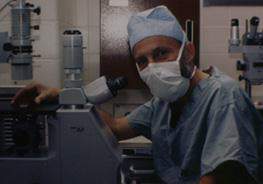
Video of Dr. Silber discussing Egg and Ovary Banking to Preserve Fertility |
|
 |
Cover story on The Riverfront Times: The Egg Man - Dr. Sherman Silber says he can extend a woman's fertility by decades. He just needs to freeze her eggs or even a piece of her ovarian tissue; October 4, 2007. |
|
 |
There are many procedures that can be used to preserve the fertility for women who are about to undergo radiation or chemotherapy for cancer. |
|
 |
"Fertility: stop all the clocks" from The London Daily Telegraph Sunday Magazine |
Egg, Ovarian Tissue, Embryo, and Sperm Freezing
Our cryopreservation (sperm, egg, embryo, and ovarian tissue storage) program is one of the best in the world. We have a 55% pregnancy rate per cycle with frozen embryos, which is no different than for fresh, or unfrozen, embryos. Our frozen embryo survival is almost 99%. Therefore, if you have "extra" viable embryos resulting from your IVF procedure, you can feel comfortable allowing us to freeze them.
We can now also offer egg freezing for women who wish to delay childbearing, and who want to preserve their fertility for the future. Although the freezing of embryos has been quite reliable, the freezing of eggs was for a long time only experimental, and, until recently, not very successful. However, the Infertility Center of St. Louis has begun a partnership with the Kato Ladies Clinic in Tokyo to bring an exciting new technique, egg vitrification [see technical video], to the United States. With this method, we can 'flash-freeze' unfertilized eggs with a remarkable effectiveness, and then thaw them at any later date for reimplantation. We can also offer ovarian tissue freezing for women who do not want to undergo IVF in the future but who just want to conceive naturally.
The classic problem with freezing eggs used to be that as one lowered the temperature below the freezing point, the egg's uncombined genetic material (ready for fertilization, but also in a complex and delicate state) would suffer damage due to ice crystals forming inside the cell. It was only possible to freeze embryos, in which the genetic material had already combined with that from the sperm, and stabilized. The classic freezing techniques (which have been known since 1983) were based on trying to extract water from the cell as the temperature drops, to minimize ice crystal damage. This has all changed now with the development of our new vitrification techniques. We no longer have to play a tenuous game of minimizing ice crystal formation -- we can now entirely avoid it -- so that there is no internal damage to the egg whatsoever.
We also offer very excellent quality ovarian tissue freezing. This procedure can be used to preserve the possibility of future fertility for women who are about to undergo radiation or chemotherapy for cancer. It may also be used for any women who may not be able to plan for children until they are older. We have had many successful ovarian tissue transplants and pregnancies, and so ovarian tissue freezing has excellent promise for preserving your natural fertility.
Sperm freezing may be needed if the husband is about to undergo radiation or chemotherapy for cancer, or is being deployed to a war zone, but wants to father children later. In addition, sperm may be frozen if the husband has no sperm in his ejaculate and requires a onetime surgical sperm extraction procedure, or simply, if the husband is afraid that on the day of your IVF procedure he may be too nervous to provide a specimen. Again, you can be very confident in the reliability of our sperm freezing and storage system.
Freezing Eggs or Embryos by the Vitrification Process
This new technique of freezing called “vitrification” avoids the damage caused by ice forming inside the cell by not trying to pull every last molecule of water out, because it is impossible to do this 100%. In fact, 70% of the cell is water, and at best you can reduce that to 30%. So with the conventional controlled rate slow-freezing technique, there is always going to be some intra-cellular ice crystal formation, causing some damage to embryos, and severely damaging most eggs. Vitrification uses a super high concentration of antifreeze (DMSO and ethylene glycol), and drops the temperature so rapidly that the water inside the cell never becomes ice. It just instantaneously super-cools into a solid with no ice crystal formation at all.
We can now freeze and thaw, and even refreeze and rethaw, with impunity, using this new protocol from Dr. Masashige Kuwayama from the Kato Clinic in Tokyo. With conventional “slow freezing,” the temperature of the embryo goes down at precisely 0.3°C per minute. With vitrification (using four times the concentration of antifreeze, or cryoprotectant), the temperature is dropped at 23,000 degrees C° per minute, that is 70,000 times faster. At that speed of cooling, and at that concentration of antifreeze, ice crystals simply cannot form.
Of course, it is not quite as simple as it might sound. Such high concentrations of antifreeze, in a few minutes, could be toxic to cells. Therefore, the embryos (or eggs) must first be placed in lower concentrations of antifreeze (and sucrose to draw some water out), and then left in high concentrations only for less than a minute before instantaneous freezing. Then when the time comes to thaw the embryo, it must be instantaneously warmed, immediately taken out of the high concentration of antifreeze, and then placed into a solution with lower concentration, in order to avoid antifreeze toxicity. This requires more skill than conventional freezing, but it is faster, cheaper, and most importantly, avoids almost all freezing damage to either eggs or embryos. Such a reliable method of embryo freezing gives the IVF program much greater ability to avoid dangerous multiple pregnancy, and makes scheduling for procedures like egg donation simpler for the patient.
Using this vitrification technique for freezing, we can reliably preserve eggs as well as embryos so that the pregnancy rate is no different than if the eggs or embryos had never been frozen. This allows us to preserve the fertility of young women for the future if they wish to delay childbearing, but not lose their fertility as they age.
See also:
Click Here for
Beating Your Biological Clock
brochure page.
If you have any questions, you may call us at (314) 576-1400.

|