+1 (314) 576-1400


 Contact Us

After three failed IUI attempts with a fertility specialist in Colorado, we decided to try IVF. That doctor didn’t want to even attempt to use my eggs, because, by that time in our attempts to have a family, I was 44. He wanted us to use donor eggs, but that didn’t feel right to me.
I came across Dr. Silber, and The Infertility Center of St. Louis doing an internet search for a solution. After scheduling an appointment, we had two mini-IVF egg retrievals. On our second trip to St. Louis, the first retrieval only yielded one viable egg and it formed a beautiful embryo. We then had another egg retrieval using the Denmark mini-IVF and retrieved 4 eggs of which yielded 3 more embryos. On our third trip, we had a second egg retrieval and an embryo transfer. We used two embryos and had the remaining two frozen to try again at a later date. I became pregnant with that first transfer.
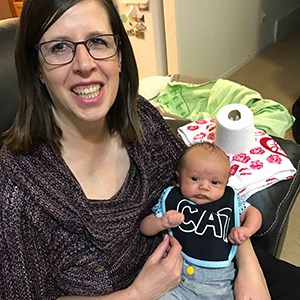
At the age of 45, I gave birth of our healthy baby boy born January 3, 2017. We couldn’t be more blessed to have found Dr. Silber, his staff, Dr. DeRosa, and the Infertility Center of St. Louis. In due time, we will do a second transfer to use the other two embryos with just as much hope as we had doing the first transfer.
Words cannot express the gratitude we have for Dr. Silber, his staff, and Dr. DeRosa for having helped us conceive our baby boy.
Infertile patients cannot afford to wait for treatment while their eggs get older.
Dr. Sherman Silber, Infertility Center of St. Louis, is offering video consultations for patients who need to plan now for their treatment while stay-at-home orders are in place. He is talking to and evaluating patients in their home to comply with social distancing measures.
Dr. Silber is discovering that patients actually prefer this method of telemedicine consultation over the conventional office visit. Patients have conveyed that “it is so much more convenient and less stressful” to have a telemedicine personal consultation than to take a day off from work to travel to the doctor’s office and sit with other nervous patients in the waiting room.
The COVID-19 pandemic is thus changing much of the way we will do things in the future, and for the better. “Our patients are surprisingly much happier with this approach. Of course, at some point we need to perform hands on treatment. But with this new manner of seeing patients, we can come to the right diagnosis and treatment plan for most patients more efficiently, quickly, and painlessly, with no loss of personal one-on-one communication.” This is a very welcome new era of telemedicine that has been forced on us by the current difficult times.